
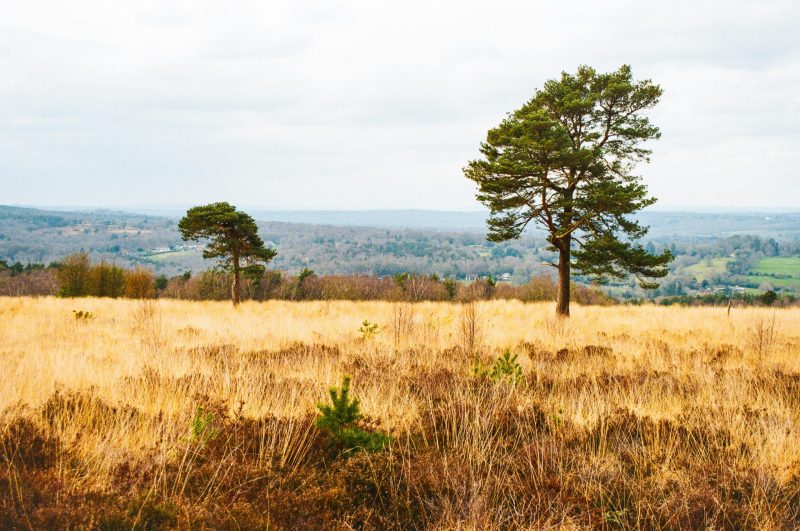
What did that hot summer do to our trees?
After a summer like this one, autumn might feel like a welcome reset. Cooler mornings, shorter days, a bit more rain…eventually. But for our trees, the story isn’t quite so simple.
Summer 2026 was provisionally the hottest summer ever recorded in the UK, with an average temperature of 16.5°C. It was also exceptionally dry in many areas. In southern England, some places went almost two months without measurable rainfall – In the whole month of July East and West Sussex recorded less than 1mm rainfall.
And trees don’t simply forget about a difficult summer when September arrives.
How our trees protect themselves
When soil dries out, trees have a clever defence mechanism. They close tiny pores on their leaves called stomata to reduce water loss. Unfortunately, these pores are also where carbon dioxide enters the leaf for photosynthesis. So when a tree closes them to save water, it also has to slow down the process that fuels growth.
Prolonged drought can therefore mean less growth, premature leaf fall and, in severe cases, dieback. Some effects may not become obvious until weeks, months or even years after the original drought. Forest Research notes that late-summer drought can affect growth in the following season, while repeated drought can have a cumulative effect leading to growth reduction many seasons on.
Not only that, but a tree weakened by drought can be more vulnerable to whatever comes next. With unpredictable seasons and extreme weather events becoming more regular, the effects of one very hot summer can easily ripple into future seasons.
How it affects our trees
This matters particularly for newly planted trees like ours. Young trees are more vulnerable to drought because their root systems are still developing so it’s not surprising that Forest Research identifies young and newly established trees as likely to be those first affected by increasing spells summer drought.
Because of this, you might see young trees in our parks start turning brown or dropping their leaves early this autumn. It doesn’t necessarily mean they have died – instead, they may be conserving resources after a stressful growing season.
Older and veteran trees aren’t immune either. Their established root systems give them advantages, but drought can still cause reduced growth and increase their vulnerability to pests and diseases. So drought is bad news for both newly planted and older trees.
What does this mean for tree planting?
At Tree Action, a summer like ours only serves to reinforce why planting a tree is only the beginning.
For new trees, good establishment matters enormously. Mulching helps retain moisture, controlling competing vegetation reduces the battle for water, and watering during prolonged dry spells can make the difference between establishment and failure. Forest Research specifically recommends mulching and careful watering as part of adapting tree planting to a drier climate.
It also gives us another reason to value autumn planting. Cooler conditions and winter rainfall give young trees time to develop their roots before the next summer arrives. The RHS is now actively encouraging people to make autumn as important a planting season as spring.
So this autumn, next time you’re in the park or woodland, take a closer look at the trees. Some will be putting on their spectacular seasonal display. Others may be quietly recovering from a summer that asked rather more of them than usual.
And as we plant new trees this season, we’ll be thinking not just about getting them into the ground, but about giving their roots the best possible start for the summers ahead.